Garis Panduan Penggunaan Kecerdasan Buatan (AI) Dalam Perspektif Maqasid Syariah
Guidelines for The Use of Artificial Intelligence (AI) in The Perspective of Maqasid Syariah
DOI:
https://doi.org/10.55265/al-maqasid.v6i1.376Keywords:
Maqasid Syariah, Kecerdasan Buatan, Ethics, Islamic LawAbstract
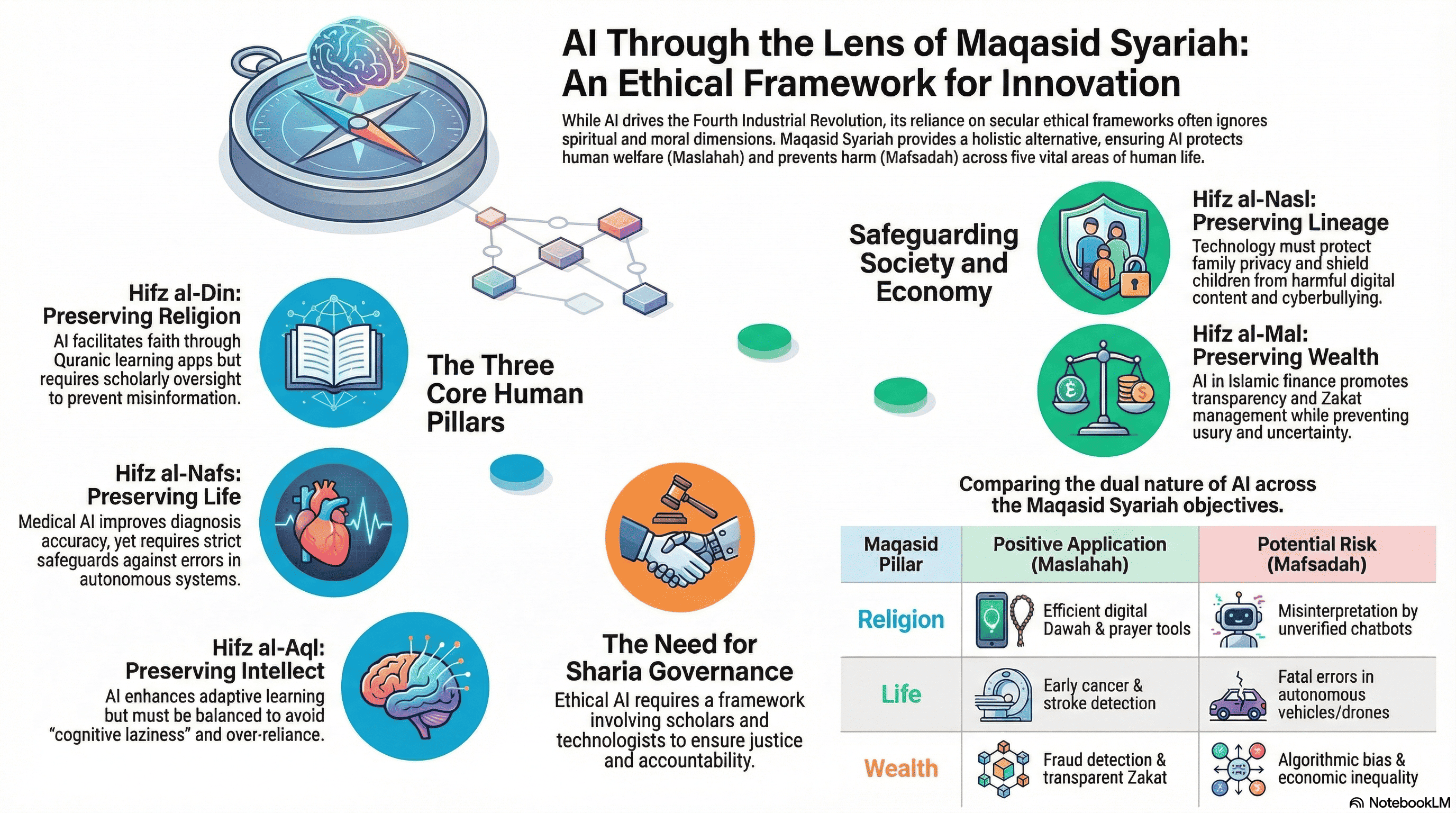
Artificial Intelligence (AI) is now utilised in various sectors, including education, healthcare, law, and public administration, making it a significant driver of the Fourth Industrial Revolution. Despite the vast potential and benefits gained by individuals who use it, numerous emerging issues related to ethics, morality and increasingly complex social responsibilities have arisen. In Islam, discussions about AI cannot be separated from the maqasid al-Shariah, which are founded on human welfare and well-being. Although Islam encourages its followers to explore knowledge and advancements such as science and technology, their use must always align with Islamic principles. This study employs a qualitative document-analysis method, examining classical and contemporary sources, including academic journals, international policies, and the views of modern Islamic scholars. The findings show that the application of Maqasid al-Shariah in AI development not only ensures that it operates properly and ethically but also transforms it into a tool that strengthens human values. In terms of Hifz al-Din (preservation of religion), AI can be utilised through Islamic applications such as prayer-time detection and Quran learning. However, AI may bring harm if used without clear Shariah guidelines. This study emphasises that ethical considerations must be integrated into the development and use of AI to produce technologies that respect individual rights and safeguard universal well-being.
Abstrak
Kecerdasan Buatan (AI) kini digunakan di pelbagai sektor dari pendidikan, kesihatan, perundangan dan pentadbiran awam menyebabkan AI adalah penyebab utama Revolusi 4.0. Di sebalik potensi dan manfaat besar yang diperoleh individu yang menggunakannya, muncul pelbagai masalah baharu berkaitan etika, moral dan tanggungjawab sosial yang semakin kompleks. Dalam Islam, perbahasan tentang AI tidak boleh dipisahkan daripada maqasid syariah yang berteraskan kemaslahatan dan kesejahteraan manusia. Walaupun Islam menggalakkan umat untuk meneroka kemajuan dan ilmu seperti sains dan teknologi, namun penggunaannya haruslah sentiasa selaras dengan tuntutan yang dianjurkan Islam. Kajian ini menggunakan metod kualitatif analisis dokumen terhadap sumber sumber klasik dan kontemporari termasuk jurnal akademik, polisi antarabangsa serta pandangan sarjana Islam moden. Dapatan menunjukkan bahawa penerapan Maqasid al-Syariah dalam perkembangan AI bukan sahaja memastikan ia berjalan dengan baik dan beretika, malah menjadikannya alat untuk memperkukuh nilai kemanusiaan. Dari segi Hifz al-Din aplikasi AI dapat dimanfaatkan melalui aplikasi islamik seperti pengesanan waktu solat dan pembelajaran Al-Quran. Namun begitu, AI boleh membawa kemudaratan jika digunakan tanpa panduan syariah yang jelas. Kajian ini menegaskan bahawa pertimbangan etika wajib diterapkan dalam Pembangunan dan penggunaan AI supaya dapat menghasilkan teknologi yang menghormati hak individu dan menjaga kemaslahatan sejagat.
Downloads
References
Abas, H. (2025, February 26). Kecerdasan Buatan Ubah Landskap Pembelajaran di Malaysia | UTM NewsHub. News.utm.my. https://news.utm.my/2025/02/kecerdasan-buatan-ubah-landskap-pembelajaran-di-malaysia/
Abu Samah, A. (2024). Kecerdasan Buatan Bertanggungjawab (Responsible AI) dalam Internet Benda (IoT): Ke Arah Masa Depan yang Selamat dan Diyakini. Wadah ICT. https://www.ukm.my/wadahict/kecerdasan-buatan-bertanggungjawab-responsible-ai-dalam-internet-benda-iot-ke-arah-masa-depan-yang-selamat-dan-diyakini/
Agil, H., Ahmad, A. L., & Azlan, A. A. (2024). Peranan dan Pengaruh Kecerdasan Buatan (AI) terhadap Industri Periklanan di Malaysia. E-Bangi Journal of Social Science and Humanities, 21(2), 303–316.
Ahmad Taha, J. Z., Sulaiman, S. Z., & Ajmain @ Jima’ain, M. T. (2025). The Use of Artificial Intelligence (ChatGPT) in Islamic Education: An Analysis of Challenges, Opportunities, and Ethical Considerations Based on Maqasid Shariah. RISE Journal. https://rise.teknologi.edu.my/index.php/journal/article/view/51/33
Al Jufri, K. A., Awang, M. S., & Sahid, M. M. (2021). Maqasid Syariah Menurut Imam al- Ghazali dan Aplikasinya dalam Penyusunan Undang-Undang Islam di Indonesia. Malaysian Journal of Syariah and Law, 9(2), 75–87.
Al Shouk, Ali. (2018). Dubai Police to Deploy Robotic Patrols. Australasian Policing, 10(1), 56.
Al-Alusi, al-Syihab al-Din a.-S. M. (1994). al-Mathani (Jilid 7, 8, 11, 15 & 21). Beirut, Lubnan: Dar al-Kutub al-‘Ilmiyyah.
Al-Fadhli, M. A., & Yahaya, M. F. (2022). Arabic Language Learning Using AI-based Tools: A Preliminary Review.
Ali. (2024). 8 Top AI Tools for Medical Diagnosis in 2025. AI Mojo. https://aimojo.io/ms/ai-tools-medical-diagnosis/
Ali. N. (2024). Kecerdasan Buatan AI untuk Pemasaran Digital yang Berkesan. Dimensi Koop.
Aliff Nawi, Yaakob, M. F. M., Chua, C. C. R.,Khamis, N. Y., & Tamuri, A. H. (2021). A Preliminary Survey of Muslims Experts’ Views on Artificial Intelligence. Islamiyyat: Jurnal Antarabangsa Pengajian Islam (International Journal of Islamic Studies), 43(2), 3–16.
Al-Qaradawi, Y. (1994). Thaqafah al-Da’iyah. Kaherah: Maktabah Wahbah.
Awang, A. H. (2020). Maqasid Shariah Menurut al-Quran dan Hadis. 2nd International Conference on Contemporary Issues in Al-Quran and Hadith 2020 (THIQAH 2020), ISBN e978-967- 2122-86-9, 281–295.
Azilawati. (2023). Apa Itu AI. Blog Azilawati. https://people.utm.my/azilawati/2023/11/15/apa-itu-ai/
Aziz, A. R. A. (2023). Penerokaan Nilai Agama Berasaskan Maqasid Syariah dalam Meningkatkan Kebahagiaan Keluarga. Malaysian Journal of Social Sciences and Humanities (MJSSH), 8(1), 2–24. e002165. https://doi.org/10.47405/mjssh.v8i1.2165
Barokah afiliet. (2025). Hifz Al-Mal. Scribd. https://www.scribd.com/document/742409652/Hifz-Al-Mal
Bernama. (2023, August 1). Kerajaan Teliti Keperluan Kawal Selia Etika Penggunaan Teknologi AI. Berita Harian Online. https://www.bharian.com.my/berita/nasional/2023/08/1134400/kerajaan-teliti-keperluan-kawal-selia-etika-penggunaan-teknologi-ai
Bernama. (2025). Malaysia Gesa Perkukuh Keselamatan AI, Kerjasama ASEAN Tangani Ancaman Siber. United Daily News.
Bouazzaouri, S., Witherow, M.A., & Castelle, K.M. (2016). Ethics and Robotics. In: Proceedings of the International Annual Conference of the American Society for Engineering Management. American Society for Engineering Management (ASEM).
Dr Mohamed Fateh Labanieh & Dr Hafidz Hakimi Haron. (2023). Gubal Kerangka Kerja AI Berdasarkan Maqasid Syariah. Berita Harian Malaysia. PressReader. https://www.pressreader.com/malaysia/berita-harian-malaysia/20231015/282291029895851
Elmahjub, E. (2023). Artificial Intelligence (AI) in Islamic Ethics: Towards Pluralist Ethical Benchmarking for AI. Journal of Philosophy & Technology, 36(3), 7–25. https://doi.org/10.1007/s1334702300668x
E-Proceedings of the 3rd INHAD International Muzakarah & Mu'tamar on Hadith (IMAM 2018). (2018). KUIS, Kajang, Selangor. Hadith Research Institute (INHAD), International Islamic University College Selangor, MALAYSIA. eISBN 978-967-44741-6-4.
European Commision. (2018). Draft Ethics Guidelnes for Trustworthy AI. https://www.euractiv.com/wp-content/uploads/sites/2/2018/12/AIHLEGDraftAIEthicsGuidelinespdf.pdf
Firmansyah, F. D. (2023). Artificial Intelligence (AI): Bagaimana Perspektif Islam?. Arrahim.ID. https://arrahim.id/fachr/artificial-intelligence-ai-bagaimana-perspektif-islam/
Habib, Z. (2025). Ethics of Artificial Intelligence in Maqaṣid Al-Sharia’s Perspective. KARSA Journal of Social and Islamic Culture, 33(1). https://ejournal.uinmadura.ac.id/index.php/karsa/article/view/19617?utm_source=chatgpt.com
Hakim, F., Fadlillah, A., & Rofiq, M. N. (2024). Artificial Intellegence (AI) dan Dampaknya Dalam Distorsi Pendidikan Islam. Urwatul Wutsqo: Jurnal Studi Kependidikan Keislaman. https://doi.org/10.54437/urwatulwutsqo.v13i1.1330
Hameed, M., Sharqi, S. S., Yaseen, Z. M., Afan, H. A., Hussain, A., & Elshafie, A. (2016). Application of Artificial Intelligence (AI) Techniques in Water Quality Index Prediction: A Case Study in Tropical Region, Malaysia. Neural Computing and Applications, 28(S1), 893–905.
House of Lords (2018) AI in the UK: Ready. Willing and Able. House of Lords Select Committee on Artificial Intelligence. Report of Session 2017–19. 18 June. London: House of Lords.
Ibn Manzur. (1955). Lisan al Arab : 15 tom. Dar Sader, Dar Beyrouth, -56.
Ismail, A. M, Subri, I. M., Baharuddin, A. S., Ab. Rahman, A. & Rosidi, M. H. (2024). The Role of Maqasid Al-Shariah in Contemporary Fatwa Formulation: A Balanced Approach. Al-Qanatir International Journal of Islamic Studies, 33(7), 1-28.
Jabatan Digital Negara. (2021). Bab 1 – Definisi Kecerdasan Buatan (AI). In Garis Panduan Pengadaptasian Kecerdasan Buatan (AI) Sektor Awam (pp. 11–32). Jabatan Digital Negara. https://www.jdn.gov.my/bab-1-definisi-kecerdasan-buatan-ai-2/#
Kannike, U. M. M., Fahm, A. O. (2025). Exploring The Ethical Governance of Artificial Intelligence from An Islamic Ethical Perspective. Jurnal Fiqh, 22(1).
Khalil, M., & Er, E. (2023). Artificial Intelligence and ChatGPT in Education: A Review of Peer Reviewed.
Khan, S., Nazir, A., & Tariq, H. (2023). Overreliance on AI Tools and the Decline of Student Cognitive Skills. Educational Technology & Society, 26(1), 12–25.
Labanieh, M. F., & Haron, H. H. (2023). Gubal Kerangka Kerja AI Berdasarkan Maqasid Syariah. Berita Harian. https://www.pressreader.com/malaysia/berita-harian-malaysia/20231015/282291029895851
Masnih Mustapa. (2025). Pendekatan Maqasid Syariah Dalam Menangani Isu Etika Kecerdasan Buatan (AI): Suatu Kerangka Konsep.
Masyhadi. (2025, July 2). The Maqashid Al-shariah Approach in Regulating the Ethics of Artificial Intelligence Use. Innovative Pedagogy and Education Studies (IPES), 2(2). 85-93. https://e-journal.icmandalika.or.id/index.php/IPES/article/view/119?utm_source=chatgpt.com
Mat Saad, H., & Rajamanickam, R. (2021). Maqasid Memelihara Akal (Hifz al-‘Aql) dan Hubungannya dengan Falsafah Pendidikan Kebangsaan [The Maqasid of protecting mind (Hifz al-‘Aql) and Its Connection with National Education Philosophy]. Islamiyyat: Jurnal Antarabangsa Pengajian Islam (International Journal of Islamic Studies), 43(Special Issue), 93–104. https://doi.org/10.17576/islamiyyat-2021-43IK-08
Mazri, N. M., Amir Nur Rashid, Z., Megat Laksamana, N. N., & Md Sawari, M. F. (2019). Kedudukan Ilmu Sains dan Teknologi Dalam Menentukan Hukum ‘Iddah dan Kesannya Terhadap Maqasid Syariah. International Journal of Business, Economics and Law, 18(6), 12–21.
Md Supi, S. S. (2017). Menunaikan Prinsip Maqasid Al-Syariah. Institut Kefahaman Islam Malaysia. https://www.ikim.gov.my/menunaikan-prinsip-maqasid-al-syariah/
Mohamad @ Razak, N. A. (2024, May 17). Kecerdasan Buatan dalam Pendidikan: Perspektif Pedagogi. E-PENA. https://epena.com.my/index.php/2024/05/17/kecerdasan-buatan-dalam-pendidikan-perspektif-pedagogi/
Mohd Azam, M. D. I., Ahmad, M. I. A., & Rosidi, M. H. (2025). The Disclosure of a Spouse’s Disgrace Before and After Divorce: A Maqasid al-Shariah-based Legal Analysis of the ‘spill the tea’ and ‘exposing ex’ Phenomenon. International Journal of Research and Innovation in Social Science, 9(6), 5200–5206.
Mohd Najib, N. W., Basarud-din, S. K., & Fazial, F. (2025). ARTIFICIAL INTELLIGENCE (AI) IN ISLAMIC FINANCE: A MAQASID AL-SHARIAH PERSPECTIVE. International Journal of Law, Government and Communication (IJLGC), 10(40). https://gaexcellence.com/ijlgc/article/view/5292?utm_source=chatgpt.com
Muqri Nizam. (2025, March 26). Maqasid Syariah dalam Penggunaan Kecerdasan Buatan (AI). The Patriots. https://thepatriots.asia/maqasid-syariah-dalam-penggunaan-kecerdasan-buatan-ai/
Mustapha, A. (2025, November 24). Adakah Kita Sebenarnya Perlukan Etika Penggunaan AI?. Bernama. https://www.bernama.com/bm/tintaminda/news.php?id=2493166
Mustapha, R., Malkan, S. N. A. (2025,). Maqasid Al-shariah in the Ai Era: Balancing Innovation And Islamic Ethical Principles. International Journal of Islamic Theology and Civilization, 3(3). https://ijitc.com/index.php/my/article/view/70?utm_source=chatgpt.com
NorizanNizan, M. N. I., Mohd Shaiful Nizam, M. A., Rosli, A. I. A., & Rosidi, M. H. (2025). USIM’s Legal Clinic and Divorce Casework: A Maqasid al-Shariah-based socio-legal study. International Journal of Research and Innovation in Social Science, 9(7), 1232–1241.
Othman, M. M., Fazil, M. F. A. M., Harun, M. H. H., Musirin, I., Sulaiman, S. I. (2019). Performance Comparison of Artificial Intelligence Techniques in Short Term Current Forecasting for Photovoltaic System. International Journal of Power Electronics and Drive Systems. 10(4):2148-2156. http://doi.org/10.11591/ijpeds.v10.i4.pp2148-2156
Pizzetti, F. G. (2019). The Robot Sophia as a “new citizen” of Saudi Arabia: What About Granting Legal Personhood, “citizenship” and Eventually Dignity to Non-Human Entities with Artificial Intelligence? Notizie di Politeia 35(133):63-70.
Razi, A. M., Rosidi, M. H., Mohd Adnan, J., Mat Yasim, D., & Abdul Majid, M. (2025). The Role of the Federal Territories Mufti’s Office in Addressing Contemporary Religious Issues in Malaysia. International Journal of Research and Innovation in Social Science (IJRISS), 9(07), 3563-3571
Rosidi, M. H., Mokhtar, A. W., & Abdul Majid, M. N. (2022). Penggunaan Media dalam Talian Menurut Perspektif Maqāṣid Al-Shari‘ah. Journal of Fatwa Management and Research, 27 (3), 78–105.
Rosie Ha. (2025). AI dalam Perubatan dan Penjagaan Kesihatan: Manfaat Utama. INVIAI. https://inviai.com/ms/ai-dalam-perubatan-dan-penjagaan-kesihatan
Rosli, F. S., Zahari, N. N., Faizolakhman, N. I., & Rosidi, M. H. (2025). The Influence of Social Media on Marital Conflict: An Analytical Study Through the Lens of Maqasid Al-Shariah in Preserving Family Stability and Dignity. International Journal of Research and Innovation in Social Science, 9(7), 598–608.
Russel, S., & Norvig, P. (2021). Artificial Intelligence: A Modern Approach (4th ed.). Prentice Hall.
Sakinah, S. (2025, April 24). Malaysia, UAE dan Rwanda Berusaha Meningkatkan Penggunaan AI, Menjambatani Jurang antara Peneraju AI Dunia. Siakap Keli. https://siakapkeli.my/2025/04/24/malaysia-uae-dan-rwanda-berusaha-meningkatkan-penggunaan-ai-menjambatani-jurang-antara-peneraju-ai-dunia
Serdianus, & Saputra, T. (2023). Peran Artificial Intelligence ChatGPT dalam Perencanaan Pembelajaran di Era Revolusi Industri 4.0. Masokan: Ilmu Sosial Dan Pendidikan, 3(1), 1–18. https://doi.org/10.34307/misp.v3i1.100
Shaip. (2025). AI dalam Penjagaan Kesihatan: Fahami Faedah dan Cabaran. Shaip. https://ms.shaip.com/blog/the-role-of-ai-in-healthcare-benefits-challenges-everything-in-between/
Sinaga, F. Y. (2025). Etika Penggunaan Kecerdasan Buatan Dalam Perspektif Islam: Mitigasi Risiko Dan Optimalisasi Manfaat. Tarbiyah Bil Qalam: Jurnal Pendidikan Agama dan Sains, 9(1). https://doi.org/10.58822/tbq.v9i1.305
Tarmizi, L. (2019). Pejabat Mufti Wilayah Persekutuan - Irsyad Usul Al-Fiqh Siri Ke- 33: Pendahuluan kepada Ilmu Maqasid Syariah. Muftiwp.gov.my; Pejabat Mufti Wilayah Persekutuan. https://muftiwp.gov.my/ms/artikel/irsyad-usul-fiqh/3099-irsyad-usul-al-fiqh-33pendahuluan kepada-ilmu-maqasid-syariah
UTM NewsHub. (2025). Perlindungan Kanak-Kanak di Era Digital Tuntut Tanggungjawab Bersama. UTM Research & Innovation. https://research.utm.my/newshub/perlindungan-kanak-kanak-di-era-digital-tuntut-tanggungjawab-bersama/
Vinothkumar, J., & Karunamurthy, A. (2023). Recent Advancements in Artificial Intelligence Technology: Trends and Implications. Quing: International Journal of Multidisciplinary Scientific Research and Development. https://doi.org/10.54368/qijmsrd.2.1.0003.
Yunus, M. I. M. (2022). Pengenalan kepada Konsep Maqasid al-Syariah. OER. OUM; Centre for Instructional Design and Technology. https://myoer.oum.edu.my/2022/05/18/pengenalan-kepada-konsep-maqasid-al-syariah/
Zabidi, A. Z. M., & Pawi, A. A. A. (2025). Prinsip Maqasid Syariah dalam Mendepani Era Kecerdasan Buatan: Perspektif Budaya Melayu. Jurnal Melayu, 24 (1), 61–71.
Zahid, M., Abdullah, P. D. M. (2025). The Ethical Implications of Artificial Intelligence (Ai) In Islamic Societies: A Critical Examination. Al-Aasar, 2(2), 803-811.
Downloads
Published
How to Cite
Issue
Section
License
Copyright (c) 2025 Nur Izzatul Husna Norshaharizal, Siti Hajar Che Mohd Zamri, Balqis Amani Zainal, Nurin Afrina Mohd Fazlee

This work is licensed under a Creative Commons Attribution-NonCommercial 4.0 International License.